
How to Choose PTFE Granular Resin: Virgin vs Filled PTFE
2 min read
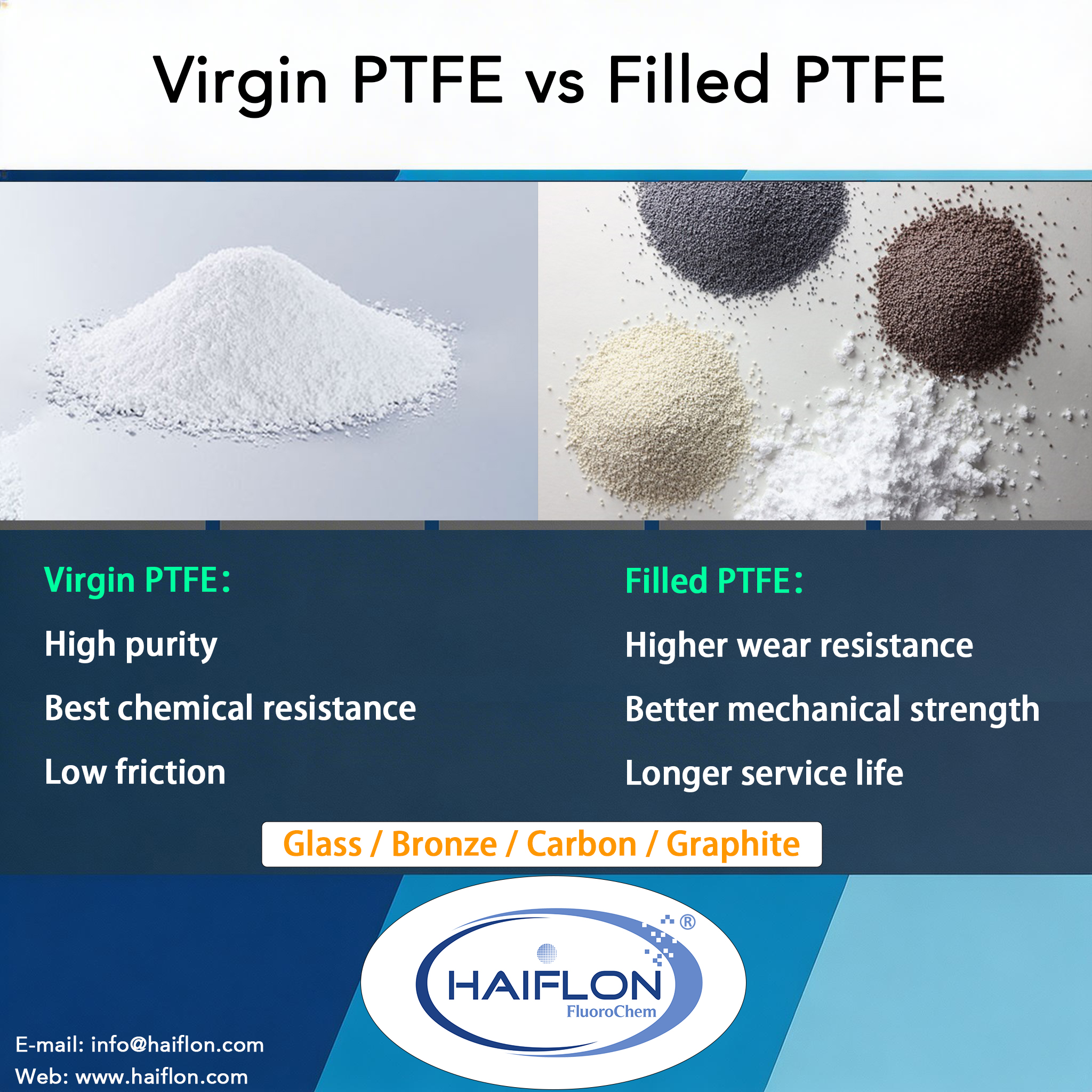
When manufacturing PTFE molded parts, one decision comes before everything else: virgin PTFE or filled PTFE?
The honest answer is that neither is “better” — they optimize for completely different failure modes. Virgin PTFE fails by chemical attack and creep; filled PTFE is built to resist wear and deformation. Your working conditions decide which matters.
Virgin PTFE granular resin
Virgin PTFE is the choice when the environment is the enemy:
- Maximum chemical resistance — essentially inert to almost everything
- Lowest friction of any solid plastic
- High purity, non-contaminating
- Best electrical insulation
Typical applications: chemical gaskets, sealing rings, electrical insulation parts, linings for aggressive media.
If your part sees mixed or unknown chemicals, high purity requirements, or mostly static loads — stay virgin.
Filled PTFE compounds
Fillers trade a little chemical universality for large gains in mechanical performance. The four workhorses:
Glass fiber filled PTFE
The general-purpose filler. Improves wear resistance, compressive strength and dimensional stability. The default for seals and gaskets under cyclic load.
Bronze filled PTFE
Up to 60% bronze. Excellent thermal conductivity and load capacity — the choice for heavy-duty bearings and bushings where heat needs to get away from the friction surface.
Carbon fiber filled PTFE
Wear resistance with low deformation under load, plus good thermal conductivity. Common in mechanical seals, piston rings and dynamic applications. Also suitable for steam service.
Graphite filled PTFE
Lowest friction of the filled grades and excellent sliding behavior — usually blended with glass or bronze for bearings, bushings and sliding pads.
Quick selection table
| Priority | Choose |
|---|---|
| Chemical resistance, purity | Virgin |
| General wear + stability | Glass fiber |
| Heavy load, heat dissipation | Bronze |
| Dynamic sealing, low deformation | Carbon fiber |
| Sliding friction | Graphite (often + glass/bronze) |
The economic argument
Filled PTFE costs more per kilogram — and usually costs less per part-life. Doubling or tripling the service life of a bearing or seal in a hard-to-access location easily outweighs a modest material premium. The most expensive PTFE grade is the one that fails early in service.
Haiflon® supplies virgin PTFE granular resin in fine-cut, semi-flow and free-flow grades plus a full range of filled PTFE compounds. Share your load, speed, temperature and media — our engineers will recommend a grade and typical formulation within 24 hours.
Frequently Asked Questions
Does filling PTFE reduce its chemical resistance?
Generally yes, depending on the filler. Glass fiber, bronze and carbon reduce resistance to strong alkalis, hydrofluoric acid or aggressive media respectively. Virgin PTFE remains the safest choice for unknown or highly aggressive chemical service.
How much does filler reduce PTFE's friction?
Fillers raise the friction coefficient slightly versus virgin PTFE (which is already extremely low), but they dramatically reduce wear rate and creep — so friction stays low for much longer in sliding service. Graphite-filled grades offer the best sliding combination.
What filler percentage is typical?
Common loadings are 15–25% by weight: 15–25% glass fiber, 60% max bronze, 15–25% carbon fiber, and around 5% graphite — often blended with another filler for balanced performance.
Related Haiflon® Products
Talk to a Haiflon® engineer
Tell us your application, target specifications and volume — we will recommend grades, share TDS and quote within 24 hours on business days.