
PTFE Granular Resin vs PTFE Fine Powder: What's the Difference?
2 min read
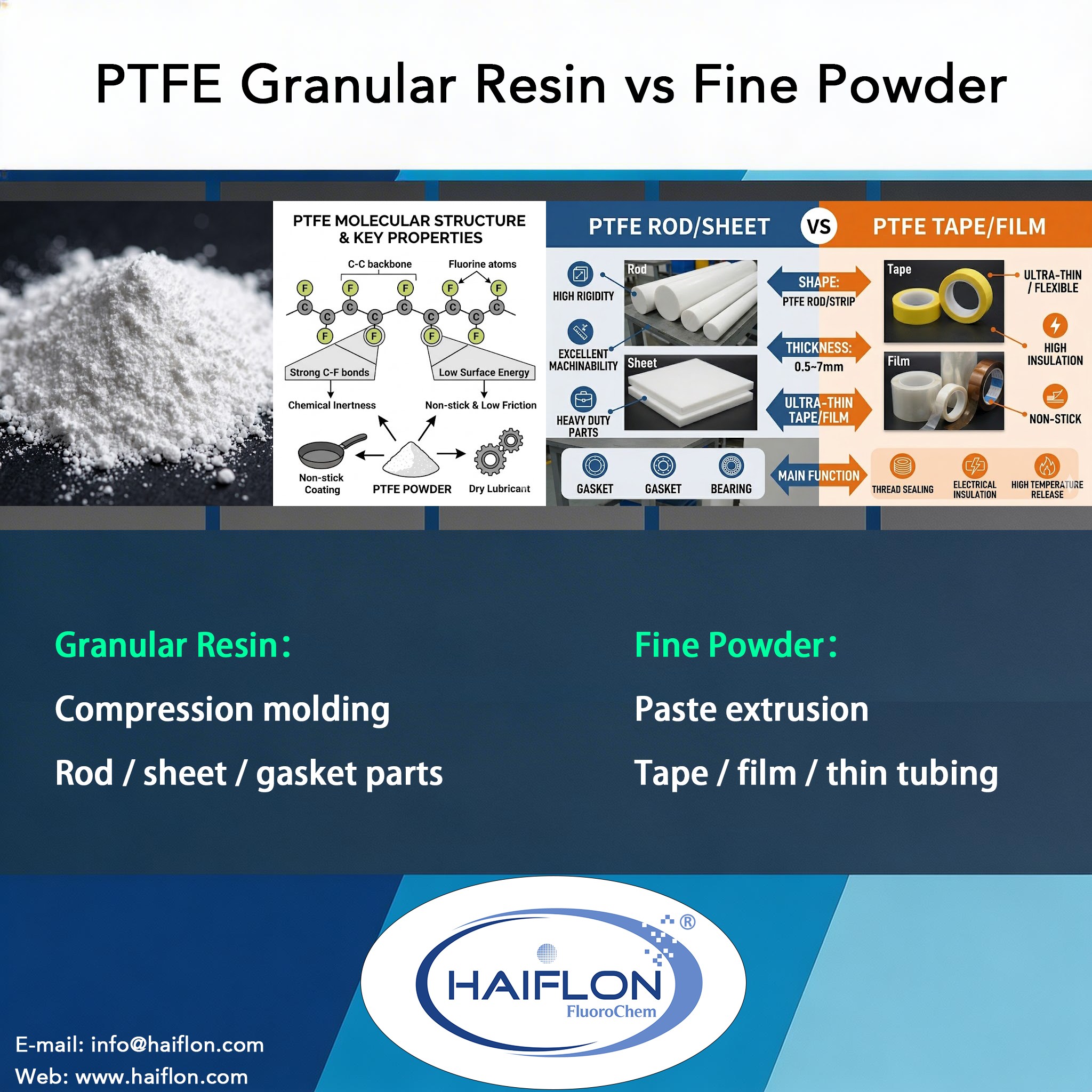
One of the most common questions from PTFE buyers: what is actually the difference between PTFE granular resin and PTFE fine powder?
The short answer: chemically they are both 100% PTFE. The difference is how they are processed — and that dictates completely different end products.
PTFE Granular Resin — the molding route
Granular resin (molding powder) is processed by compression molding and sintering:
- Powder is pressed into a preform at 15–50 MPa
- The preform is sintered at ~380 °C
- The billet is machined or skived into finished parts
Typical products:
- Rods, sheets and tubes
- Gaskets and sealing rings
- Valve seats and pump parts
- Bushings and wear components
If the part is solid, thick or machined, it comes from granular resin.
PTFE Fine Powder — the paste extrusion route
Fine powder (paste-extrusion grade) is processed very differently: it is mixed with a hydrocarbon lubricant, preformed, then extruded at high reduction ratios. The emulsion-polymerized particles fibrillate under shear, forming a strong network — before sintering, the lubricant is removed and the part is sintered or left unsintered.
Typical products:
- PTFE thread seal tape
- Thin-wall tubing
- Skived film and tapes
- Wire insulation for coaxial cable
If the part is thin-walled, flexible or continuous in length, it comes from fine powder.
The key insight
The difference is not the chemical structure — it is the processing technology.
| Granular resin | Fine powder | |
|---|---|---|
| Polymerization | Suspension | Emulsion (dispersion) |
| Processing | Compression molding + sintering | Paste extrusion |
| Product form | Solid, machined parts | Thin-walled, flexible, continuous |
| Typical items | Rods, gaskets, valve seats | Tape, tubing, film |
Choosing the wrong one is an expensive mistake: fine powder can cost several times more per kilogram, and granular resin simply cannot be paste-extruded.
How this affects sourcing
Because the two routes need different polymer structures, a supplier’s granular resin and fine powder are effectively two separate product lines with different quality controls. When you request a quote, specify not just “PTFE” but the processing route and end product — a serious supplier will ask for this anyway.
Haiflon® supplies both lines: PTFE granular resins (fine-cut, free-flow, pre-sintered, compounds) and PTFE fine powder for paste extrusion. Not sure which your process needs? Send us the end product and we will confirm within one business day.
Frequently Asked Questions
Can I mold parts from PTFE fine powder?
Technically yes, but it is rarely economical. Fine powder costs significantly more and its particle structure offers no advantage in compression molding. It is designed for paste extrusion with a lubricant and high reduction ratios.
Can I paste-extrude granular resin?
No. Granular resin lacks the fibrillation capability of emulsion-polymerized fine powder, so it cannot form the fibril network that gives paste-extruded products their strength.
Which one is used for thread seal tape?
PTFE fine powder, always. Tape is a classic paste-extruded product — it requires unsintered fine powder with high reduction ratio capability.
Related Haiflon® Products
Talk to a Haiflon® engineer
Tell us your application, target specifications and volume — we will recommend grades, share TDS and quote within 24 hours on business days.