
What Is PTFE Granular Resin and What Is It Used For?
2 min read
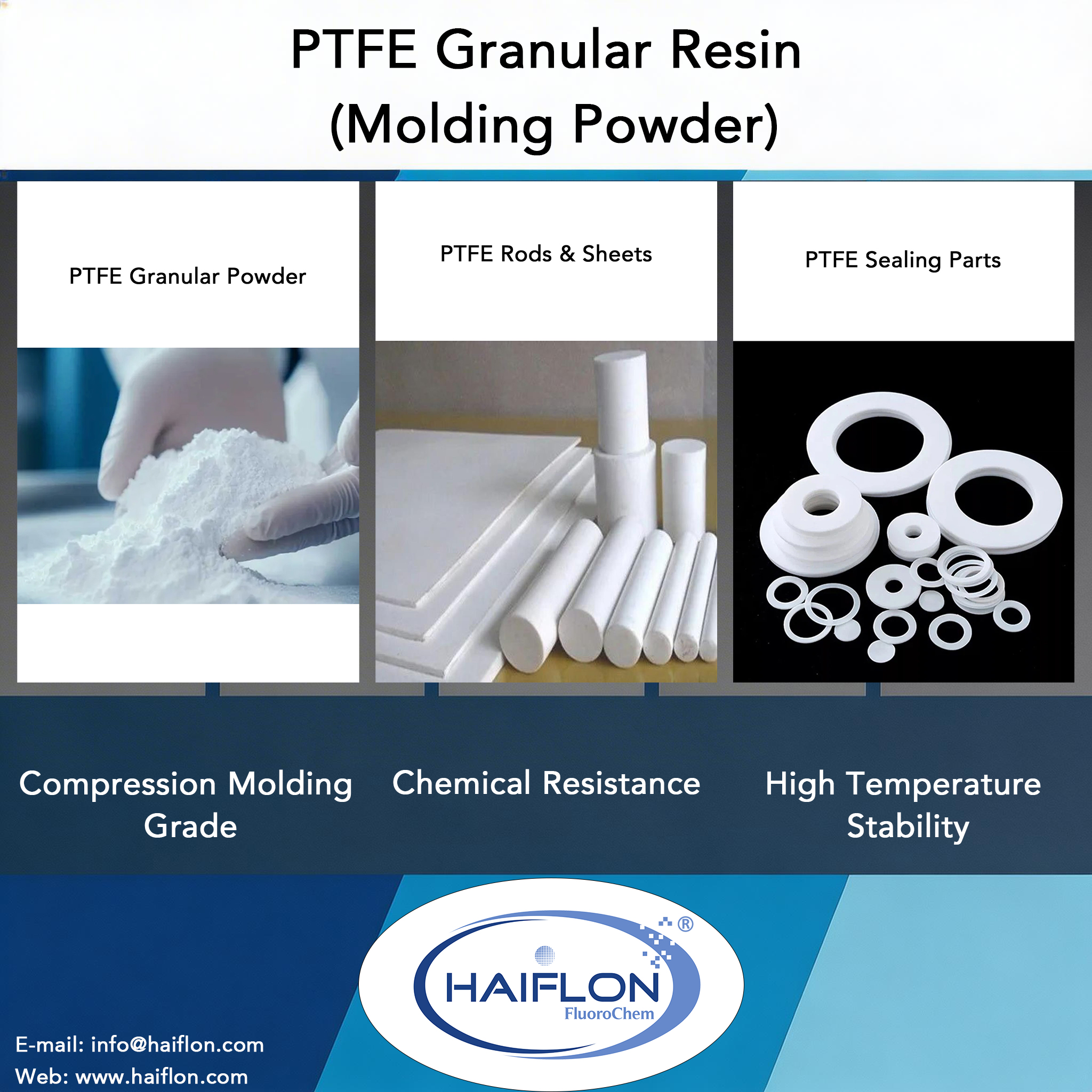
PTFE granular resin — often called PTFE molding powder — is the raw material behind most solid PTFE parts you see in industry: rods, sheets, gaskets, valve seats and pump components. If your part is molded, sintered and then machined, it started life as granular resin.
It is produced by suspension polymerization, which creates relatively large, free-flowing particles. That particle structure is exactly what compression molding needs — and it is the main difference from PTFE fine powder, which is made by emulsion polymerization for paste extrusion.
What parts is it used for?
PTFE granular resin is converted into semi-finished and finished parts by compression molding, sintering and machining:
- Rods, sheets and tubes — the stock shapes most machining shops start from
- Gaskets and sealing rings — the largest application in chemical processing
- Valve seats and pump components — where chemical inertness matters most
- Bushings and wear parts — usually filled grades (see below)
Why engineers specify it
PTFE’s property set is unmatched among plastics for harsh environments:
- Excellent chemical resistance — essentially inert to nearly all industrial chemicals
- Continuous temperature rating up to 260 °C
- Very low coefficient of friction
- Strong electrical insulation across a wide frequency range
- Long service life with no embrittlement or aging
For sealing, chemical processing and mechanical applications, this combination is why PTFE granular resin remains the default material — decades after its invention.
Virgin or filled?
Virgin granular resin maximizes chemical resistance and purity, and is the standard for gaskets and seals. When wear, creep or load capacity becomes the limiting factor, filled compounds step in:
- Glass fiber — wear resistance and dimensional stability
- Bronze — thermal conductivity and load capacity
- Carbon fiber — wear resistance with lower deformation under load
- Graphite — lower friction for sliding service
The choice is application-driven, and choosing correctly can multiply service life. See our guide on virgin vs filled PTFE for the decision framework.
Sourcing note
Consistent particle size distribution (PSD) and controlled shrinkage lot-to-lot matter more than any datasheet number when you are machining precision parts. When evaluating suppliers, ask for typical PSD curves and sintering recommendations, not just ASTM test values.
At Haiflon® (Shanghai Fluorochem), we supply PTFE granular resin and filled PTFE compounds for industrial applications worldwide — from fine-cut and free-flow grades to pre-sintered and compounds. Browse the PTFE granular resin range or send us your application for a grade recommendation.
Frequently Asked Questions
Is PTFE granular resin the same as PTFE fine powder?
No. Both are 100% PTFE chemically, but granular resin is made by suspension polymerization and processed by compression molding plus sintering, while fine powder is made by emulsion polymerization and processed by paste extrusion into thin-walled products such as tape and tubing.
What temperature can PTFE granular resin withstand continuously?
PTFE offers continuous service up to 260 °C (500 °F), with short excursions higher. This is one of the highest continuous-use temperatures of any commercial plastic.
Which PTFE grade should I use for gaskets?
Virgin fine-cut granular resin is the standard choice for chemical gaskets. For heavy-duty or wear-prone parts, filled compounds (glass fiber, bronze, carbon fiber) extend service life. Share your media, temperature and compression data and we will recommend a grade.
Related Haiflon® Products
Talk to a Haiflon® engineer
Tell us your application, target specifications and volume — we will recommend grades, share TDS and quote within 24 hours on business days.