
PTFE vs PVDF: Which Fluoropolymer Should You Choose?
3 min read
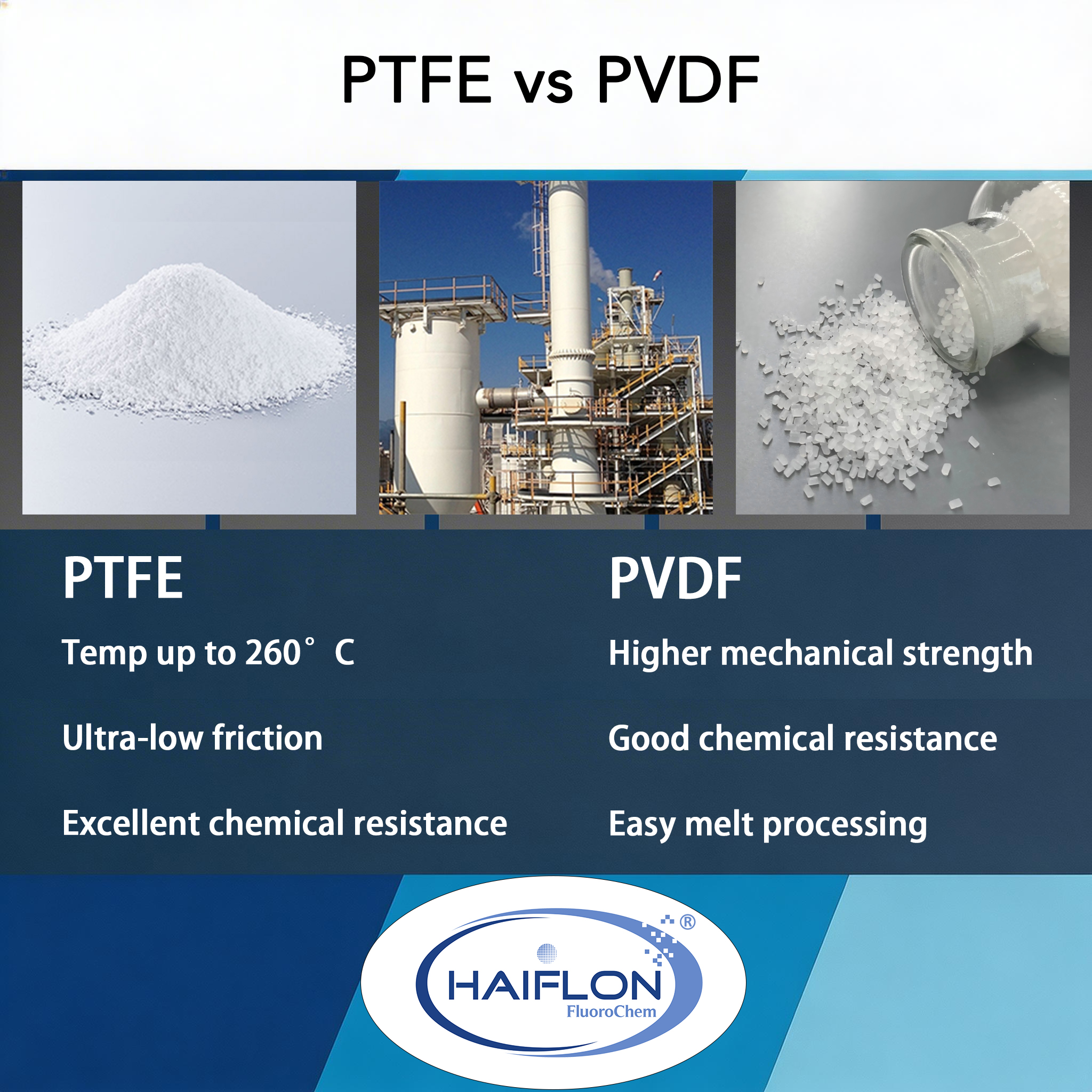
When engineers select materials for chemical processing, piping systems or industrial components, two fluoropolymers dominate the shortlist: PTFE and PVDF. Both belong to the same family and both outlast ordinary plastics in harsh environments — but their properties and processing methods differ enough that choosing the wrong one is expensive. The short answer: PTFE wins on chemical inertness, temperature and friction; PVDF wins on mechanical strength, stiffness and ease of fabrication.
Here is the comparison that settles the decision for most projects.
PTFE: the inertness benchmark
PTFE (polytetrafluoroethylene) is the most chemically resistant commercial plastic. Its defining properties:
- Outstanding chemical resistance — nearly universal; only molten alkali metals and a handful of exotic media attack it
- Extremely low friction coefficient — the lowest of any solid engineering material
- Continuous temperature up to 260°C
- Excellent non-stick properties — almost nothing adheres to its surface
- Processed by compression molding or paste extrusion, then sintered
That last point is the constraint. PTFE does not melt-flow in a conventional sense, so it cannot be injection molded and cannot be welded by normal means. Parts are molded and sintered, which shapes what you can economically make: seals, gaskets, bearings, linings and machined components rather than complex thin-wall geometries. For a fuller picture of how granular PTFE grades map to molding and sintering, see PTFE granular vs fine powder.
PVDF: the processable workhorse
PVDF (polyvinylidene fluoride) trades some inertness for practicality. Its profile:
- High mechanical strength and hardness — considerably tougher and stiffer than PTFE
- Good chemical resistance across most acids, halogens and industrial media
- Continuous temperature around 150–170°C
- Excellent UV resistance — the basis of decades-long architectural coatings
- Processable by injection molding or extrusion, and weldable into fabricated systems
Because PVDF is a true melt-processable thermoplastic, it fits ordinary manufacturing: pipes, fittings and valves can be molded, extruded and welded on standard equipment. That is why PVDF dominates chemical piping, pump components and tank linings where systems must be fabricated and joined in the field. It is also the standard binder in lithium-ion battery electrodes, an application built on its adhesion, electrochemical stability and solvent processability.
Side-by-side decision guide
The comparison reduces to a few decisive variables:
- Temperature: above about 170°C, PTFE is the only choice of the two — it carries 260°C continuous service
- Chemical exposure: for the most aggressive acids, solvents and mixed media, PTFE’s resistance is unmatched; PVDF covers a broad but not universal envelope
- Mechanical load: where parts see pressure, abrasion or impact, PVDF’s strength and hardness outperform PTFE, which creeps under load
- Fabrication: if the part must be injection molded, extruded or welded, PVDF; if it can be molded and sintered or machined, PTFE
- Friction and non-stick: PTFE is in a class of its own
Typical outcomes follow directly: PTFE goes into seals, gaskets, bearings and high-temperature environments, while PVDF goes into chemical piping, valves, pumps and lithium battery applications. In many real systems the two cooperate — PVDF piping carries the process, PTFE gaskets seal the joints.
At Shanghai FluoroChem Industry, we supply both materials: PTFE suspension resins for molding and sintering, PVDF homopolymer and PVDF copolymer grades for melt processing. Choosing the right fluoropolymer depends on your temperature, mechanical requirements and processing method — share your application and we will help you match the material to the duty.
Frequently Asked Questions
What is the main difference between PTFE and PVDF?
The main difference is processability versus ultimate performance. PTFE is the most chemically inert fluoropolymer and handles 260°C continuously, but it cannot be melt-processed — parts are made by compression molding or paste extrusion. PVDF is melt-processable with much higher mechanical strength and hardness, making it easier to fabricate, though its chemical resistance and temperature range are narrower.
When should I choose PTFE over PVDF?
Choose PTFE when the application combines high temperature, aggressive chemicals or a need for ultra-low friction. Seals, gaskets and bearings in chemical or thermal service, linings exposed to strong acids or solvents, and non-stick surfaces all favor PTFE. If the duty exceeds PVDF's 150–170°C range or its chemical envelope, PTFE is the safer specification.
Why is PVDF used in lithium battery applications?
PVDF is the standard binder in lithium-ion electrodes because it adheres strongly to active materials, stays electrochemically stable at high cell voltages and dissolves in NMP solvent for slurry coating. PTFE cannot take this role: it is not melt- or solvent-processable in the way electrode manufacturing requires, and PVDF's mechanical toughness holds the electrode structure together through cycling.
Related Haiflon® Products
Talk to a Haiflon® engineer
Tell us your application, target specifications and volume — we will recommend grades, share TDS and quote within 24 hours on business days.