
Why PTFE Micropowder Is Used in Industrial Coatings
3 min read
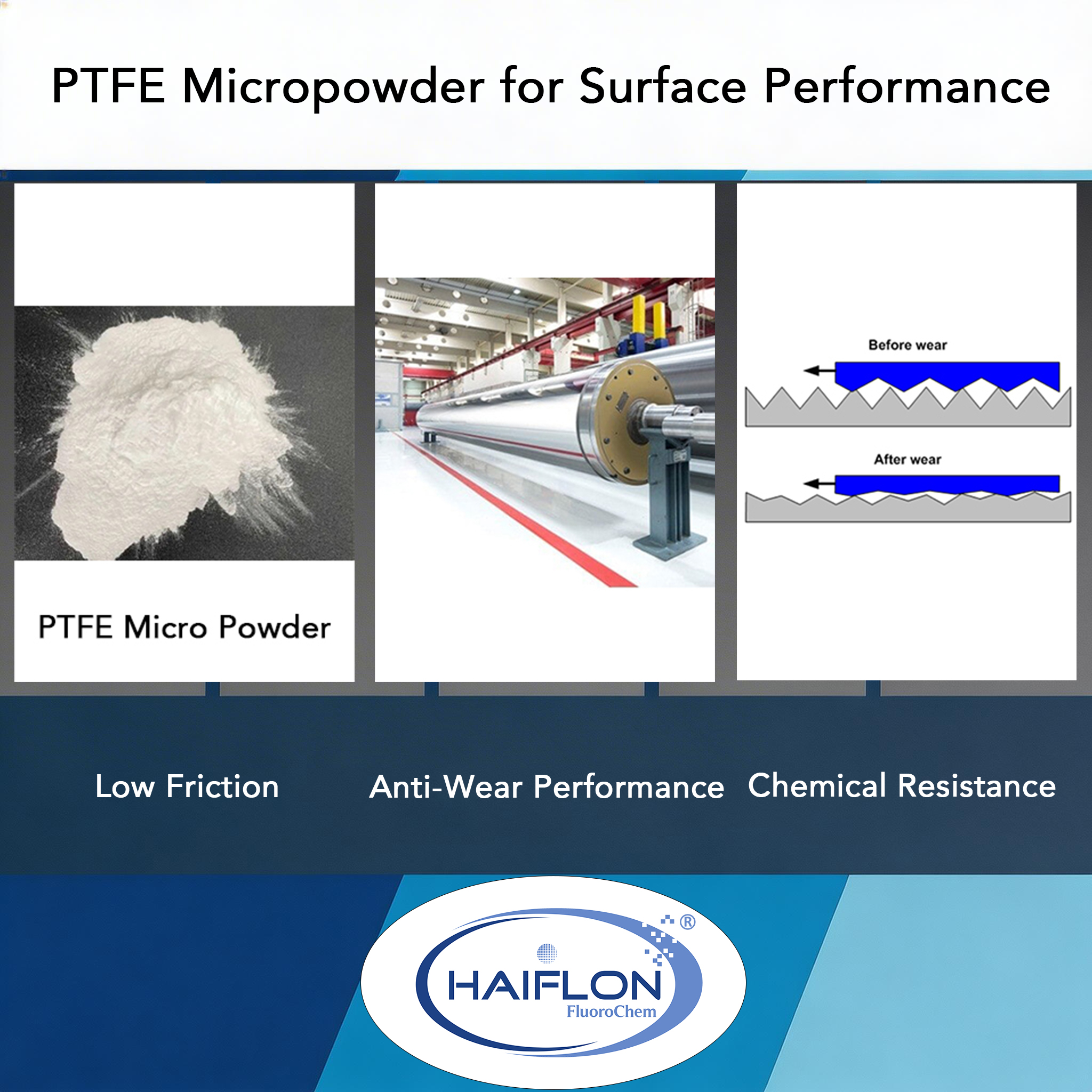
In many industrial environments, the surface of a part takes more punishment than the bulk material behind it: sliding contact, abrasion, repeated cleaning, stacking and handling. That is why PTFE micropowder has become one of the most widely used functional additives in coatings, inks and engineering plastics. The short answer to why it works: PTFE carries the lowest friction coefficient of any common solid, and micronized particles of it transfer that property directly to the surface where wear actually happens.
Here is how the additive delivers value, and where formulators use it.
What PTFE micropowder changes on the surface
PTFE — polytetrafluoroethylene — owes its surface behavior to its fully fluorinated molecular structure: strong carbon-fluorine bonds shielded by fluorine atoms produce weak intermolecular attraction and exceptional chemical inertness. Micropowder is simply PTFE reduced to fine particles so it can be dispersed into liquid formulations.
Once incorporated into a coating or ink and cured into a film, the particles concentrate at the surface and deliver five measurable benefits:
- Low coefficient of friction — parts slide instead of grabbing, reducing wear on both mating surfaces
- Excellent anti-wear performance — the PTFE-rich surface layer sacrifices itself slowly, protecting the film underneath
- Improved scratch resistance — fine particles disrupt crack propagation across the film
- Enhanced surface smoothness — better slip and feel, less blocking between stacked parts or sheets
- Outstanding chemical resistance — the surface tolerates aggressive cleaners, solvents and process chemicals
The dosage economics are the quiet advantage: a small addition rate in the formula transforms surface properties without rebuilding the coating system around it.
Where formulators put it to work
The same property set appears across four main application families:
- Industrial coatings — non-stick and easy-clean finishes, corrosion protection systems, powder coatings on machinery and fasteners
- Printing inks — rub resistance and slip for packaging that survives printing, converting, stacking and transport
- Engineering plastics modification — compounding PTFE micropowder into thermoplastics to cut friction and wear in gears, bearings and sliding components
- Lubricating materials — dry-film lubricants and greases where the PTFE particles carry the load between surfaces
For a manufacturer trying to extend product lifespan, the decision usually comes down to exposure profile. If the failure mode is abrasion, scuffing or high friction, PTFE micropowder is often the single most cost-effective modification available. If the failure mode is chemical attack, PTFE’s inertness addresses that too — which is why the additive appears in such chemically diverse markets.
For background on where this material sits in the fluoropolymer family, see our guide to what fluoropolymers are and why they matter.
Choosing and specifying the grade
PTFE micropowder is not a single product — particle size distribution, and whether the powder is derived from suspension or dispersion polymer, shape how it disperses and performs in a given system. A practical selection process looks like this:
- Define the target property: friction, wear, scratch resistance or slip
- Match particle size to film thickness — particles must sit within the cured film, not protrude
- Check compatibility with the binder and dispersion equipment on your line
- Verify the surface specification — coefficient of friction, rub count or scratch testing — against your end-use requirements
At Shanghai FluoroChem Industry, we supply PTFE micropowder in suspension-polymerized and dispersion-polymerized grades for global industrial customers. If your products require low friction or improved wear resistance, share your application and we will help you select the right grade.
Frequently Asked Questions
What does PTFE micropowder do in a coating formulation?
PTFE micropowder acts as a functional additive that migrates to the coating surface during film formation. Once there, its particles reduce the coefficient of friction, improve abrasion and scratch resistance, and add a smoother feel. Typical loading is a small percentage of the formulation, yet the surface properties change dramatically because the effect is concentrated exactly where wear happens.
Why is PTFE so effective at reducing friction?
PTFE has one of the lowest coefficients of friction of any solid material, a result of its fully fluorinated molecular structure. The fluorine atoms shield the carbon backbone, giving weak intermolecular forces that let PTFE slide easily against other surfaces. Dispersed as fine particles in a coating, it supplies this low-friction property to the surface without compromising the base binder.
Can PTFE micropowder be used in printing inks?
Yes. In inks, PTFE micropowder improves rub resistance and slip, so printed surfaces survive handling, stacking and transport without scuffing. It also reduces blocking between sheets and gives a smoother finish. The same logic extends to engineering plastics modification and lubricating materials where surface durability matters.
Related Haiflon® Products
Talk to a Haiflon® engineer
Tell us your application, target specifications and volume — we will recommend grades, share TDS and quote within 24 hours on business days.