
What Are Fluoropolymers and Why Do They Matter?
4 min read
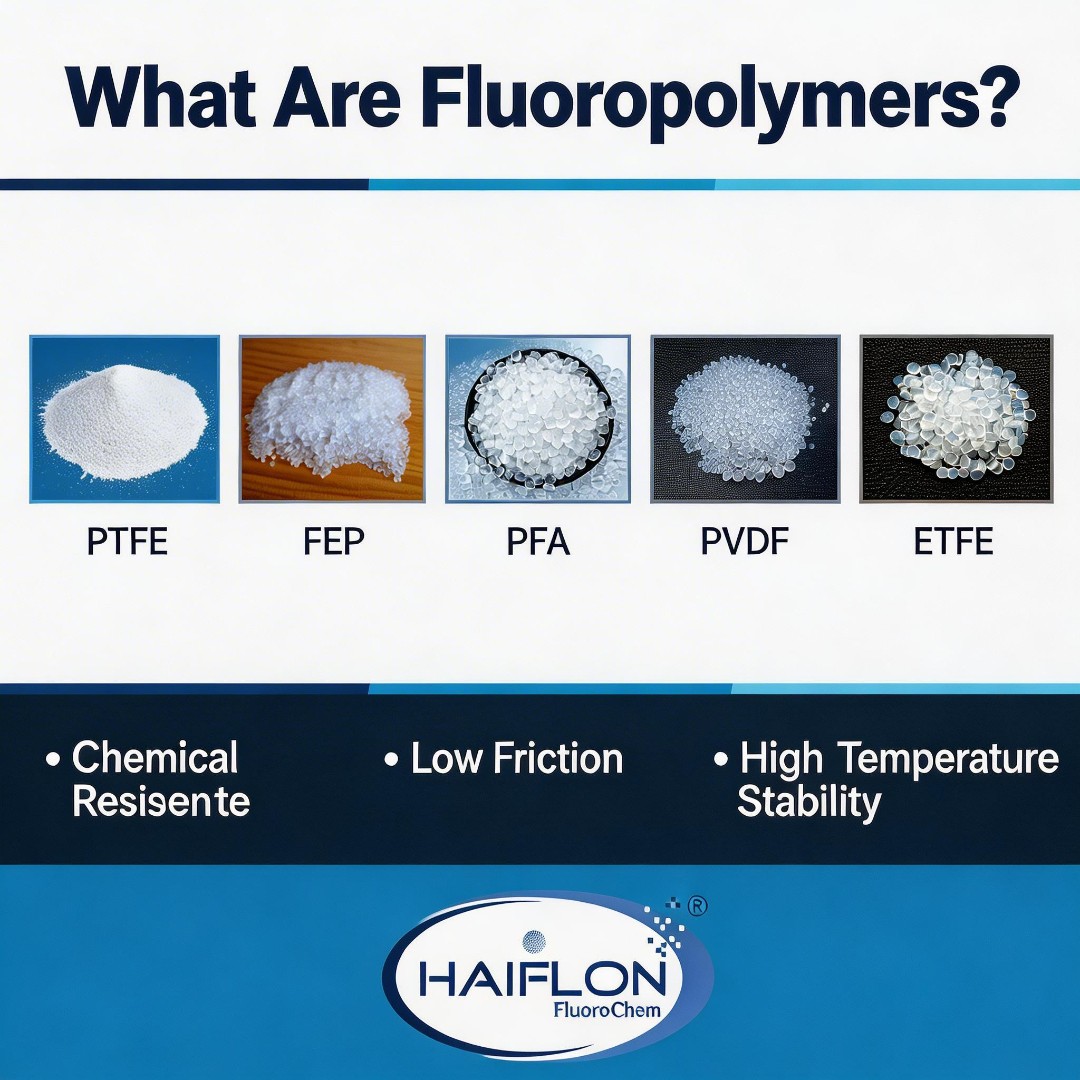
Fluoropolymers are a family of high-performance plastics in which most of the hydrogen atoms on the carbon backbone are replaced by fluorine. That single chemical change produces a combination of properties almost no other material class can match — and it is why fluoropolymers such as PTFE, FEP, PFA, PVDF and ETFE have become essential in chemical processing, semiconductor manufacturing, energy and electrical industries.
Here is what makes them special, which families matter, and where industry relies on them.
The carbon-fluorine bond advantage
The secret is the carbon-fluorine bond, one of the strongest bonds in organic chemistry. It shields the polymer backbone from chemical attack and locks in a set of properties:
- Exceptional chemical resistance — fully fluorinated grades are essentially inert to acids, bases, solvents and fuels
- Extremely low friction — PTFE’s coefficient of friction is among the lowest of any solid material
- Outstanding electrical insulation — stable across a wide frequency and temperature range
- Wide operating temperature range — PTFE serves continuously from cryogenic conditions up to 260 °C
- Excellent weather and UV resistance — decades of outdoor exposure with minimal degradation
No other engineering plastic combines all five at once, which is exactly why designers reach for a fluoropolymer when failure is not an option.
How fluoropolymers are made
All fluoropolymers start from fluorinated monomers — most importantly tetrafluoroethylene (TFE), the building block of PTFE. Polymerizing TFE in water gives two different product families depending on the process:
- Suspension polymerization produces PTFE granular resin, the molding powder behind rods, sheets and machined parts
- Emulsion polymerization produces PTFE fine powder, which is paste-extruded into tape, tubing and film
Copolymerizing TFE with other monomers creates the melt-processable families: adding hexafluoropropylene (HFP) yields FEP, adding perfluoroalkyl vinyl ether yields PFA, while polymerizing vinylidene fluoride or ethylene with TFE gives PVDF and ETFE respectively. The recipe chosen at this stage decides whether the final material can be sintered like PTFE or melt-processed like a normal thermoplastic — and that, in turn, decides what you can manufacture with it.
The main fluoropolymer families
Each family balances fluorine content against processability:
- PTFE — the original and most inert; molded and sintered or paste-extruded into seals, gaskets, tubing and machined parts
- FEP — melt-processable, with excellent clarity and chemical resistance for tubing and wire insulation
- PFA — melt-processable like FEP but with PTFE-level temperature capability; the standard for high-purity semiconductor fluid handling
- PVDF — partially fluorinated; the highest mechanical strength of the group, known for battery binders and architectural coatings
- ETFE — tough, puncture-resistant film material for greenhouses, facades and wire insulation
For a deep dive on one family, see where PVDF is used in industry or our guide to PTFE granular resin.
Where industry relies on fluoropolymers
Their property mix makes fluoropolymers the default choice in five broad sectors:
- Chemical processing — lined pipe, vessels, seals and hoses that carry aggressive media for years without corroding
- Semiconductor manufacturing — PFA tubing, valves and fittings handling ultra-pure and corrosive process chemicals
- Lithium battery production — PVDF binders holding electrode coatings together in every lithium-ion cell
- Wire and cable insulation — FEP and PFA insulation for plenum cables, aerospace wiring and high-temperature harnesses
- Industrial coatings — PTFE micropowders improving wear resistance, non-stick behavior and weatherability
Why demand keeps growing
As industries push toward higher reliability, longer service life and harsher operating environments, materials that fail once can cost far more than they save. Fluoropolymers keep winning specification battles precisely because they remove failure modes other materials leave open — corrosion, friction, thermal aging and contamination.
Three trends are reinforcing that position. Chemical and energy producers are running more aggressive processes at higher temperatures. Electronics and semiconductor fabs demand ever-cleaner fluid handling, which favors fully fluorinated, low-extractable materials. And the electric vehicle boom has made PVDF one of the fastest-growing fluoropolymer applications, since every lithium-ion cell relies on it as an electrode binder.
For engineers, the practical takeaway is simple: when a polymer problem keeps recurring — a seal that swells, a bearing that wears, a cable that cracks, a coating that chalks — there is a good chance a fluoropolymer already solves it in another industry.
At Haiflon® (Shanghai Fluorochem), we supply a range of fluoropolymer materials — from PTFE and FEP to PVDF, PFA and beyond — for industrial customers worldwide. Browse the PTFE dispersion range or PVDF homopolymer grades, or share your application and we will point you to the right family first, the right grade second.
Frequently Asked Questions
Are all fluoropolymers chemically inert?
No. Fully fluorinated polymers such as PTFE, FEP and PFA are essentially inert to nearly all industrial chemicals, while partially fluorinated types such as PVDF and ETFE trade some chemical resistance for higher mechanical strength and easier melt processing. The right choice depends on which media and temperatures your application actually sees.
What is the difference between PTFE and PFA?
Both are fully fluorinated and offer similar chemical resistance and temperature capability. PTFE is processed by molding and sintering or paste extrusion, while PFA is melt-processable like a conventional thermoplastic, which enables smooth, high-purity tubing and injection-molded components for semiconductor and pharmaceutical use.
Which fluoropolymer is best for outdoor weathering?
PVDF is the standard choice for architectural coatings thanks to outstanding UV resistance and decades of color retention. ETFE film is widely used in greenhouse and facade applications for the same reason. Both combine fluoropolymer weatherability with mechanical strength that fully fluorinated grades lack.
Related Haiflon® Products
Talk to a Haiflon® engineer
Tell us your application, target specifications and volume — we will recommend grades, share TDS and quote within 24 hours on business days.