
Where Is PVDF Used? Key Industrial Applications
3 min read
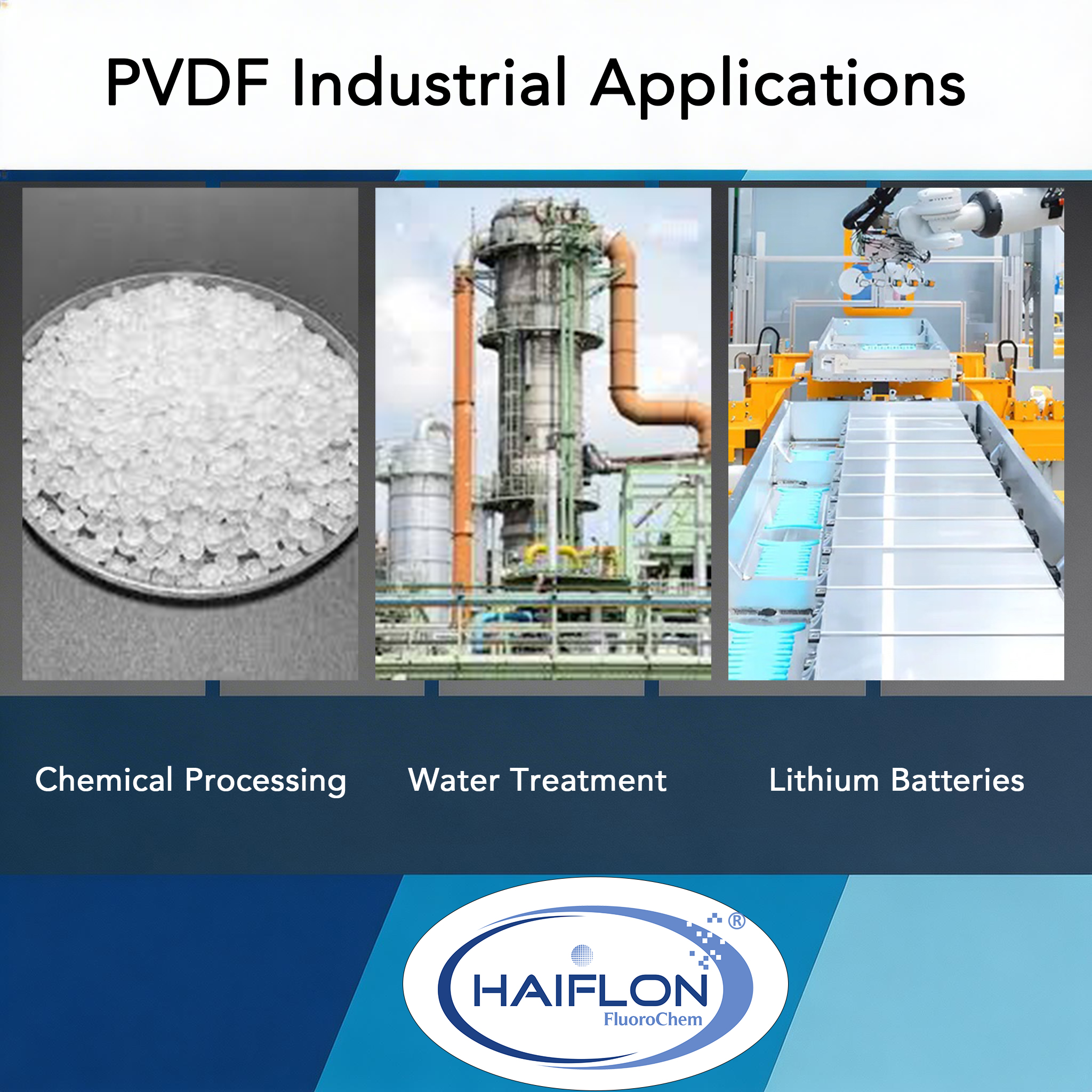
PVDF — polyvinylidene fluoride — is one of the most versatile fluoropolymers in modern industry. Fully fluorinated PTFE leads on chemical inertness, but PVDF answers a different question: it offers strong chemical resistance together with the mechanical strength, hardness and melt processability of an engineering thermoplastic. That combination puts it in four industries where long service life in harsh conditions is the entry requirement.
Two PVDF families cover most needs. PVDF homopolymer delivers the highest strength, hardness and temperature resistance, and dominates coatings, piping and battery binders. PVDF copolymer, modified with small amounts of comonomer, improves flexibility, impact resistance and processing behavior — useful for films, tubing and linings that must survive vibration or mechanical stress. Choosing between them is often the first decision in a PVDF project.
Here is where PVDF is actually used, and why.
Chemical processing systems
In chemical plants, PVDF appears wherever aggressive media meets moving or pressurized equipment:
- Pipes, valves and fittings made from solid PVDF or used as linings inside steel components
- Pump housings and pump internals handling acids, halogens and salt solutions
- Tanks, vessels and scrubbers where corrosion protection must last decades
Because PVDF is melt-processable, these components can be injection molded, extruded and welded — a major practical advantage over PTFE, which cannot be welded by conventional means. The material keeps a smooth surface that resists fouling and scaling, keeping flow rates stable over long campaigns.
Lithium battery production
Every lithium-ion cell on the market depends on PVDF. As the binder in electrode formulations, PVDF holds active material particles and conductive additives together and anchors them to the current collector — on cathodes and, in many designs, on anodes too.
The role demands a rare combination: strong adhesion, electrochemical stability at high voltages, and processability in NMP solvent for slurry coating. As battery production scales worldwide, PVDF has become one of the highest-profile fluoropolymer applications by volume. For context on how fluoropolymers divide up the industrial map, see our overview of what fluoropolymers are and why they matter.
Water treatment and filtration
PVDF membranes are a standard material in ultrafiltration and microfiltration:
- Municipal and industrial wastewater treatment
- Desalination pretreatment
- Food and beverage clarification
- Biopharmaceutical filtration
The membrane chemistry resists chlorine and aggressive cleaning agents, so plants can disinfect aggressively without destroying the membrane. High mechanical strength also lets PVDF membranes handle backwashing cycles repeatedly over a long service life.
Architectural coatings
PVDF-based coatings are the benchmark for outdoor weatherability. Applied as factory-applied finishes on aluminum and galvanized steel, they protect:
- High-rise building facades and curtain walls
- Roofing panels and cladding
- Stadium and airport structures
The coating’s outstanding UV resistance means color and gloss survive decades of sunlight — a big reason PVDF coatings are specified for landmark buildings.
Why specifiers keep choosing PVDF
Across all four sectors the logic is the same: PVDF buys fluoropolymer durability in a form ordinary manufacturing can use.
- It is a true thermoplastic — moldable, extrudable, weldable
- Its mechanical strength and abrasion resistance exceed those of fully fluorinated grades
- Its chemical resistance covers most industrial media at typical operating temperatures
- Its weatherability is proven over decades of outdoor exposure
The trade-offs are just as clear. PVDF does not match PTFE’s chemical universality or its 260 °C service temperature, and it is not the right material for the most extreme acid and solvent service. But in the very large middle ground between “ordinary plastic fails” and “only fully fluorinated PTFE survives,” PVDF is usually the most practical and economical answer — easier to fabricate, stronger in service and available in homopolymer and copolymer grades tuned to the duty.
At Shanghai FluoroChem Industry, we supply PVDF homopolymer and PVDF copolymer grades for global industrial customers, alongside the wider fluoropolymer range. If you are working with PVDF, share your application and we will help you match the grade to the duty.
Frequently Asked Questions
Why is PVDF used as a binder in lithium-ion batteries?
PVDF combines strong adhesion to electrode materials, electrochemical stability at high cell voltages and good processability in NMP solvent. It holds active material particles and conductive additives together on both cathodes and anodes while withstanding years of charge-discharge cycling without degrading.
How does PVDF compare with PTFE?
PTFE is more chemically inert and handles higher temperatures, but it must be molded and sintered or paste-extruded. PVDF is a melt-processable thermoplastic with much higher mechanical strength and hardness, so it can be injection molded, welded into piping systems and used where abrasion and pressure rule out PTFE.
Is PVDF suitable for outdoor architectural applications?
Yes, and it is the benchmark. PVDF-based coatings retain color and gloss for decades under UV exposure, which is why they are specified for high-rise facades, roofing panels and stadium structures. The same weatherability carries over into industrial equipment installed outdoors.
Related Haiflon® Products
Talk to a Haiflon® engineer
Tell us your application, target specifications and volume — we will recommend grades, share TDS and quote within 24 hours on business days.