
Why Engineers Choose FEP for Wire & Cable Insulation
3 min read
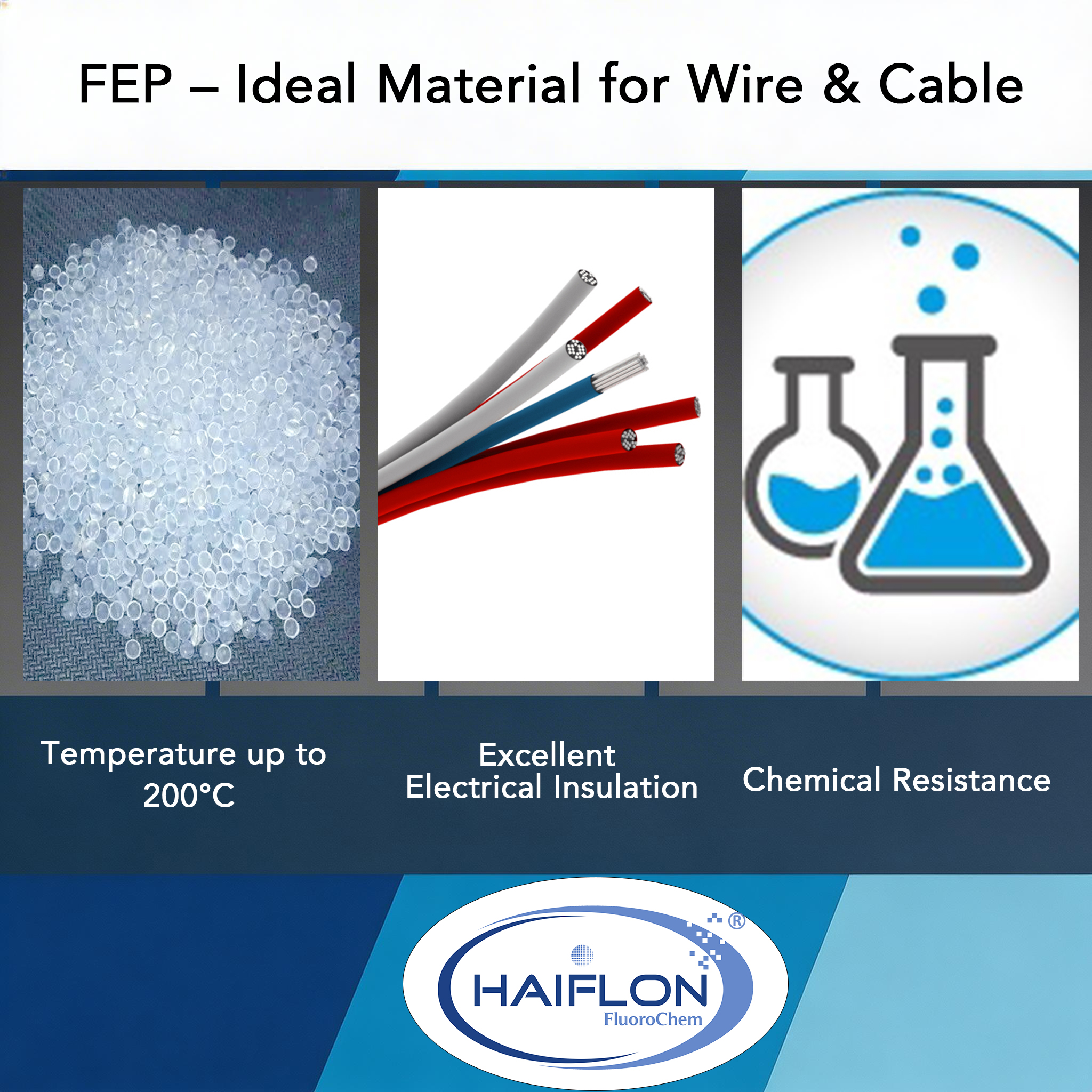
When a cable has to survive heat, chemicals and years of continuous duty, the insulation material becomes the most important design decision on the spec sheet. For a large share of demanding applications, engineers settle on FEP — fluorinated ethylene propylene. The short answer to why: FEP combines the chemical resistance of the fluoropolymer family with true melt processability, so it delivers near-PTFE performance at production speeds that PTFE cannot match.
Here is what that combination means in practice, and where FEP insulation earns its place.
Electrical insulation you can count on
FEP’s first claim to fame is its electrical insulation performance. It has very high dielectric strength, low dielectric constant and low dissipation factor, and — critically — these values stay stable across temperature, frequency and humidity. For high-performance wire & cable insulation, that stability is what keeps signal integrity intact in instrumentation circuits, communication equipment and data transmission lines.
The practical consequences show up across industries:
- Consistent impedance in data and communication cables
- Reliable isolation in multiconductor instrumentation cable
- Low signal loss in high-frequency electronics applications
- Dependable performance where moisture or condensation is present
Because FEP is melt-processable, it extrudes into a smooth, uniform insulation layer with tight dimensional control. A clean, smooth surface also means easier stripping and termination on the production line — a small detail that saves real labor cost in high-volume assembly.
Chemical and environmental resistance
The second pillar is the fluoropolymer inheritance. FEP shrugs off acids, bases, solvents and fuels that would embrittle or dissolve ordinary insulation materials such as PVC or polyethylene. In chemical processing plants, refineries and offshore installations, cables face a constant chemical attack; FEP-insulated cable keeps performing where alternatives crack, swell or short out.
Outdoor exposure tells the same story. FEP has outstanding weather and UV resistance, so insulation installed in direct sunlight retains its flexibility and electrical properties for years. Add continuous operating temperature up to 200°C, and you have an insulation system that covers most industrial environments without derating or special protection.
For engineers comparing fluoropolymer options, the position is easy to summarize: PTFE offers the ultimate in chemical inertness and a 260°C ceiling but cannot be melt-extruded, while FEP covers slightly less extreme conditions in a form that modern cable lines can process efficiently. Our overview of what fluoropolymers are and why they matter places FEP within the wider family.
Where FEP is actually used
The property set above maps onto four main application areas:
- High-performance wire & cable insulation — instrumentation, control and power cable in harsh environments
- Industrial tubing — chemical and fluid handling lines that benefit from the same inertness
- Electronics and communication equipment — hook-up wire, coaxial constructions and high-frequency assemblies
- Chemical processing systems — cabling and components exposed to aggressive media
In each case the selection logic is identical: the environment rules out commodity plastics, the duty demands stable electrical properties, and volume production rules out materials that cannot be melt-processed. That triple filter lands on FEP remarkably often.
Specifying FEP with confidence
As modern industries demand higher reliability and durability, fluoropolymers like FEP keep expanding their role in advanced engineering materials. When you specify FEP insulation, the checklist is straightforward:
- Confirm the maximum ambient and conductor temperature stays within the 200°C continuous rating
- Check chemical exposure against FEP’s resistance data for your media
- Evaluate the required dielectric performance at your operating frequency
- Match the FEP grade — resin for extrusion, dispersion for thin-wall coatings — to the manufacturing process
At Shanghai FluoroChem Industry, we supply FEP materials — including FEP resin for melt extrusion and FEP dispersion for coating applications — to customers across industries worldwide. If your project involves FEP or other fluoropolymers, share your application and we will help you match the grade to the duty.
Frequently Asked Questions
What continuous temperature can FEP insulation handle?
FEP insulation is rated for continuous service up to 200°C. That covers most industrial and electronics environments, including equipment rooms, engine compartments and outdoor installations with high solar gain. For applications that must exceed 200°C, engineers typically move up to PFA, which extends the temperature envelope while keeping melt processability.
How is FEP different from PTFE in cable applications?
Both deliver excellent chemical resistance and electrical performance, but FEP is melt-processable while PTFE is not. FEP can be extruded directly onto conductors at high line speeds, giving smoother, more uniform insulation with lower processing cost. PTFE requires paste extrusion or tape wrapping, which suits special geometries rather than volume cable production.
Is FEP suitable for outdoor cable installations?
Yes. FEP has outstanding weather and UV resistance, so its electrical and mechanical properties barely change after years of sun exposure. This makes it a reliable choice for outdoor instrumentation cable, telecom and communication equipment, and any installation where the jacket or insulation sees direct sunlight without additional protection.
Related Haiflon® Products
Talk to a Haiflon® engineer
Tell us your application, target specifications and volume — we will recommend grades, share TDS and quote within 24 hours on business days.